
Harrisburg City Directory Collections
The historical directory shelf for Dauphin County is centered on Harrisburg. The Historical Society of Dauphin County directory holdings identify an unusually long, but not unbroken, run: 1839; 1842; 1843; 1852; 1856; 1858; 1860; 1863-64; 1866-67; 1869; 1871-1947; 1949-56; 1958-76; 1979-82; and 1986-99. These books generally list residents and businesses alphabetically, often with an address and occupation. A few also include organizations, nearby places, or a street-number section.
| Collection | Years represented | Holding location | Access route |
|---|---|---|---|
| HSDC Harrisburg city directories | 1839-1999, with stated gaps | HSDC Alexander Family Library | On-site historical collection; selective material is digitized |
| East Shore Harrisburg directories | 1861-1901 | Dauphin County Library System, East Shore Area Library | On-site microfilm |
| HSDC directory advertisement scans | 1839, 1842, 1843, 1852, 1856, 1858-59, 1863-64 | Rawn Journal Project | Selected scans online |
| Polk's Greater Harrisburg City Directory | 1904 example | Google Books, original held by Pennsylvania State University | Page-level online searching |
The gaps are holdings gaps. They do not show that no directory was printed, and they should never be read as proof that a person left town. Harrisburg is the strongest focus of these volumes. Some books also reach places such as Steelton and Middletown, but that inclusion varies by volume and does not make the set a countywide directory for every locality.
Dauphin County Directory Library Shelves
The HSDC Alexander Family Library is at 219 S. Front Street in Harrisburg. Its listed directory collection sits beside church baptisms, marriages and deaths, cemetery inventories, birth and death registries, will extracts, Orphans' Court extracts, late-nineteenth-century atlases, and selected Sanborn maps. The library lists hours from 1 to 4 p.m. Tuesday through Friday and the second Sunday, and asks researchers to confirm before travel. Its phone is 717-233-3462.
For a second local shelf, the Dauphin County Library System says East Shore Area Library holds Harrisburg City Directories from 1861 through 1901 on-site, plus local newspaper microfilm and selected Pennsylvania county histories. A missing web index is not a dead end. It means the practical route is the microfilm reader, the historical library, or a request for help locating a dated volume.
HSDC also publishes a research-fee schedule. Nonmember self-directed research is listed at $10 per day, while members are free. Staff research is listed at $20 per hour on-site or $25 per hour off-site, each with a two-hour minimum; copying and postage can add to the total. Those options matter when a specific volume, obituary, or archival item cannot be consulted in person.
The Dauphin County Library System collection page documents the local-library route for historical material.

That route is useful when a year falls inside the East Shore microfilm run but is not among a readily available digitized volume.
- Write down the person's surname, initials, address, and a target year before opening a volume.
- Check the closest available Harrisburg directory, then copy the entry exactly, including abbreviations.
- Compare the nearest earlier and later held years instead of assuming a single listing settles an identity.
- Use a map, census image, newspaper, church record, cemetery inventory, or estate extract to test the address and family connection.
Note: HSDC publishes research and copy options, but its holdings description is not a unified online name index.
Reading Harrisburg City Directory Entries
A Harrisburg city directory entry is evidence from one publication date, not a complete biography. The observed 1904 directory examples include “Bradley Florence M., teacher, h 802 Capital” and “Bradley James, fireman, h 333 Reily.” They show why initials, street spelling, and the surrounding alphabetical entries matter. An entry may help distinguish two people with one surname, but it may still require a second record before it can be assigned to a family.
| Person name | Surname, given name, and often a middle initial form the alphabetic identity clue. |
|---|---|
wid [given name] | A widow notation, such as “wid Robert J.,” is directory grammar, not a vital-record substitute. |
| Occupation or role | Entries may record a role such as teacher, fireman, laborer, or chemist; its presence varies. |
h [address] | The observed h abbreviation marks a residence address, not an exact move date. |
| Repeat-address shorthand | Some entries use shorthand such as do; read the surrounding page before expanding it. |
- Criss-cross directory
- A secondary list organized by street number rather than alphabetically by name. HSDC reports that only some volumes have one.
- Householder index
- An index arranged around the named household contact. It can be a starting clue, not proof of every member of a home.
- Abbreviation key
- The explanatory key in a volume's front matter. Photograph or transcribe it before interpreting short forms in individual listings.
Harrisburg Street-Number Directory Lists
Selected Harrisburg city directories have a second, street-number listing. That reverse or criss-cross feature can turn a historic address into a name and business clue, but it is volume-specific. Look first for an address-organized section in the same year rather than assuming every book has one. The result should then be checked against the alphabetic entry, where initials and occupation may clarify a match.
Older addresses need care. The City of Harrisburg's house-history and Sanborn guide says Cameron Street was formerly 11th Street and Green Street was formerly Two and One Half Street. It also warns that individual house numbers may change. Those are Harrisburg continuity clues, not a countywide renumbering rule. Search both historical forms before treating an address as absent.
A modern parcel, owner, or deed search follows a different record path; the address-keyed tools belong on the Dauphin County street directory page. Here, the value is the dated printed list and its neighborhood context.
Harrisburg Directory Advertisement Scans
HSDC's directory advertisement scan page adds source detail that a bare title page may not show. It has selected advertisement scans for 1839, 1842, 1843, 1852, 1856, 1858-59, and 1863-64. The 1858-59 volume is identified as Wallace & Phillips' Business Directory of Harrisburg, Lancaster, Columbia and York, and Rural Villages Adjacent, published in Baltimore. Preserve that title and publisher in research notes instead of labeling every item simply as a city directory.
The Rawn Journal Project scan collection shows the volume-specific advertising material.
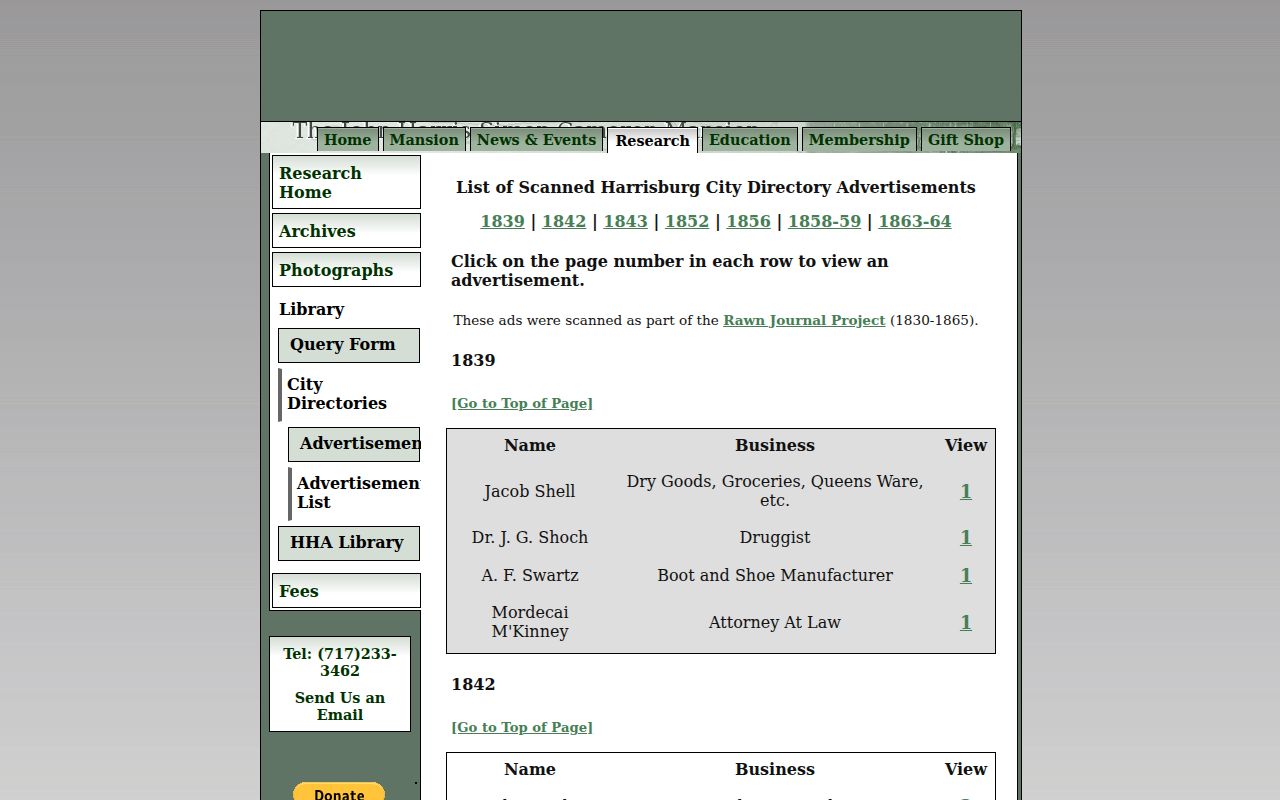
These scans identify selected volumes and their commercial context, but they are not a complete digitized run or a substitute for reading the directory pages.
| 1839 | Earliest year listed among HSDC's selected advertisement scans. |
|---|---|
| 1858-59 | Wallace & Phillips volume named by HSDC, covering Harrisburg and adjacent places in its title. |
| 1863-64 | Latest period listed among the selected scan years. |
| 1999 | Last stated HSDC holding year, not a verified final publication year for all Harrisburg directories. |
Dauphin County Directory Companions
Directory evidence is stronger when it is paired with another local source. HSDC reports roughly 900 manuscript groups that include family papers, deeds from the 1700s, organizational records, maps, and photographs. Its library also names church records, cemetery inventories, newspaper clippings, and court extracts. A dated directory entry can therefore lead to a better question: does the same name, address, or event appear in a separate contemporaneous record?
The HSDC archives overview is a collection-level starting point, not an online name search.
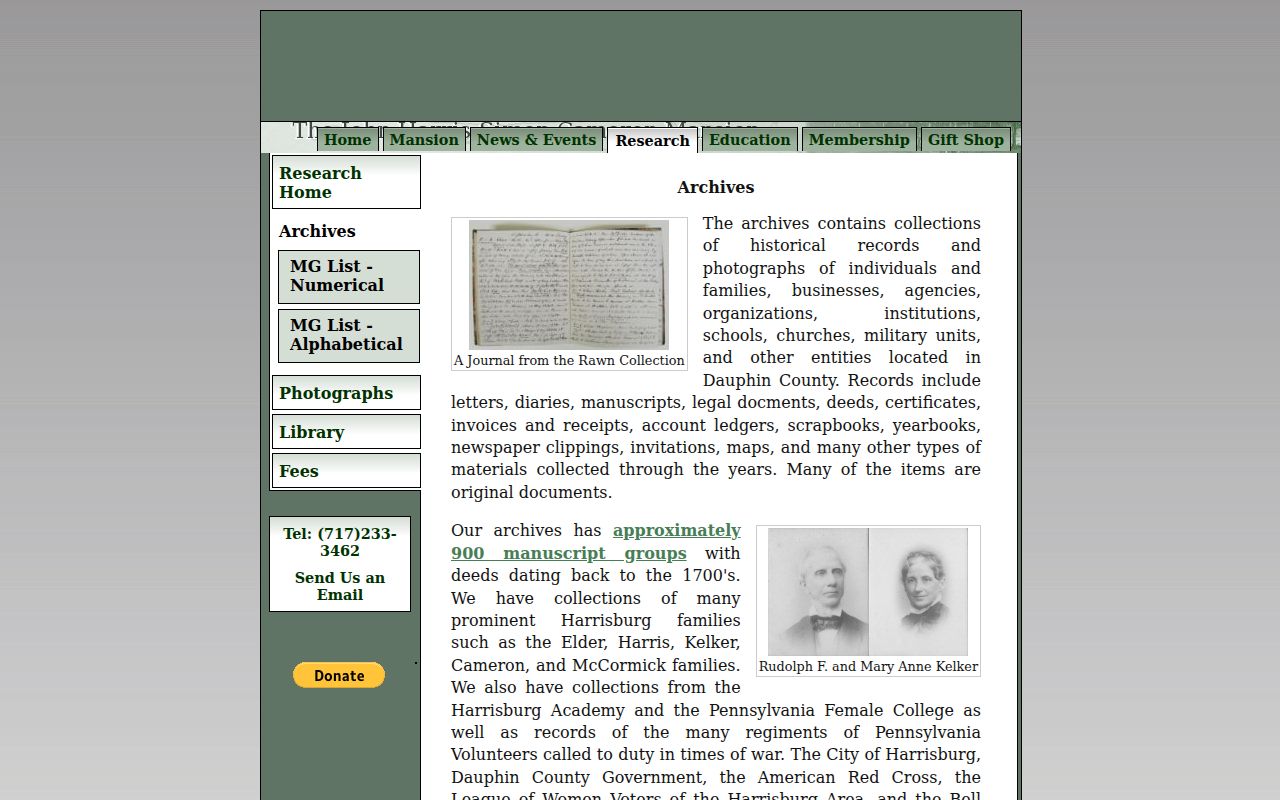
Contact the library before assuming that a named manuscript group can be searched remotely or copied without a collection-specific request.
The State Library of Pennsylvania genealogy collection is another catalog route for Pennsylvania historical research.

Use a catalog result to identify the holding and then confirm the item's date, format, and access terms with the repository.
Tracing Households in Harrisburg City Directories
For family history, begin with the directory year nearest a known address or event. Record the exact spelling, initials, street, and occupation notation. Then check the prior and next available HSDC year. A name that shifts from an initial to a full given name, or from one street to another, may be meaningful, but it still needs confirmation. The 1904 Polk's Greater Harrisburg City Directory is a useful digitized example of the form of evidence.
- Find a person or address in the closest available directory year and save the full entry with its page context.
- Check earlier and later held volumes for changes in spelling, address, occupation, or widow notation.
- When a volume has a street-number list, compare the address entry with the alphabetic listing.
- Pair the directory sequence with a federal census. The 1950 Census is freely searchable by name, location, or enumeration district.
- Test the proposed household with a contemporaneous newspaper, church or cemetery record, estate extract, or map before drawing a conclusion.
Federal census schedules from 1790 through 1950 are public under the 72-year rule, but they are household snapshots rather than a substitute for a municipal directory. An omission from a directory may reflect a move, a death, a spelling variation, an unlisted person, or a missing held year. It does not establish absence by itself.
Note: Keep the published spelling and street form in your notes, even when a later record uses a modern version.
Harrisburg Maps Beside Directories
A printed address becomes more useful when it is read beside the right map. Penn State Digital Collections’ 1884 Harrisburg Sanborn map can help place a directory street and building in context. It does not identify a person by itself. The City guide identifies Sanborn editions for 1884, 1890, 1905, and 1929, which can help bracket a physical building's change over time.
For the historic street-name issues noted above, test the old and newer names in a directory, census index, map, and deed description. Retain the source's original form alongside any normalized modern address. That simple practice avoids connecting a correct family to the wrong block after a street or house number changed.